Maple Tree
Sugar-rich broadleaf of North America and East Asia
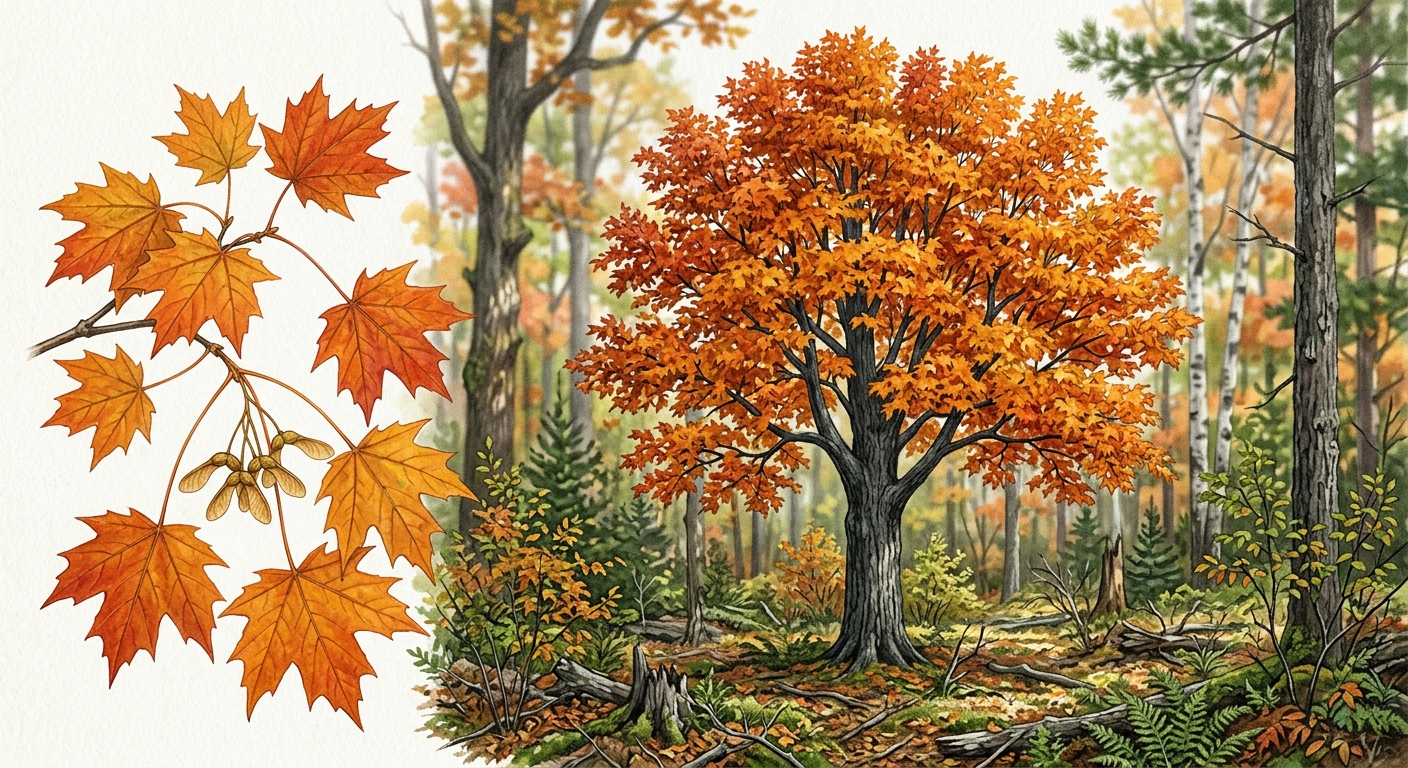
Acer saccharum, the sugar maple, is a large deciduous tree native to eastern North America renowned for its brilliant autumn foliage and as the primary source of maple syrup. This long-lived hardwood is ecologically important in temperate forests and culturally significant to the region.
Overview
The sugar maple (Acer saccharum) is a dominant canopy tree in the hardwood forests of eastern North America, reaching heights of 25-35 meters with a dense, rounded crown. It is most famous for its sap, which contains higher sugar concentrations than other maple species, making it the preferred tree for maple syrup production. The species plays a vital ecological role, providing food and habitat for numerous wildlife species and contributing to nutrient cycling in forest ecosystems. Sugar maples are slow-growing but exceptionally long-lived trees, often surviving 300-400 years under favorable conditions. They are shade-tolerant when young, allowing them to regenerate successfully under closed forest canopies. The tree's wood is highly valued for furniture, flooring, and musical instruments due to its hardness, fine grain, and attractive appearance. The species is perhaps best known for its spectacular fall color, with leaves turning brilliant shades of yellow, orange, and red depending on weather conditions and individual tree genetics. This autumn display attracts millions of visitors to regions where sugar maples are abundant. The tree is also an important indicator species for forest health and climate change impacts in temperate North American ecosystems.
How to identify
Sugar maple leaves are palmately lobed with 5 (occasionally 3) lobes, typically 8-14 cm long and wide, with smooth margins between the pointed lobes and no teeth. The leaves are dark green above and lighter below, turning vibrant yellow, orange, or red in autumn. The bark is gray-brown, becoming deeply furrowed with long, irregular plates on mature trees. The tree produces paired winged seeds (samaras) that form a U-shape with wings nearly parallel or forming angles less than 90 degrees. Mature trees develop a broad, rounded crown and can reach heights of 25-35 meters with trunk diameters of 60-90 cm.
Habitat
Sugar maples thrive in well-drained, moist, fertile soils in temperate deciduous and mixed forests. They prefer cool, humid climates and are common in upland areas, slopes, and valleys. The species is often found in association with American beech, yellow birch, eastern hemlock, and other northern hardwoods. Sugar maples are shade-tolerant, particularly when young, and can persist in the forest understory for decades.
Distribution
Native to eastern North America, ranging from Nova Scotia and Quebec west to Manitoba and Minnesota, south to northern Georgia and east Texas. The species is most abundant in the northern United States and southeastern Canada, particularly in New England, New York, Pennsylvania, and the Great Lakes region. It has been planted ornamentally beyond its native range in parts of the Pacific Northwest and Europe.
Diet
Sugar maples require well-drained, slightly acidic to neutral soils (pH 6.0-7.5) rich in organic matter. They prefer full sun to partial shade once established, though saplings are shade-tolerant. The trees have moderate water needs and perform best with consistent moisture, though mature specimens can tolerate short dry periods. They are sensitive to soil compaction, road salt, and air pollution.
Behavior
Sugar maples exhibit determinate growth, with a single flush of shoot elongation in spring followed by bud set. The trees produce copious sap flow in late winter and early spring when freeze-thaw cycles create pressure differentials. Leaves emerge in mid to late spring and fall in autumn after displaying vibrant colors. The species demonstrates strong apical dominance when young, developing a single main trunk, but the crown becomes more spreading and rounded with age. Sugar maples are allelopathic to some degree, with their leaf litter potentially inhibiting growth of certain understory plants.
Reproduction & life cycle
Sugar maples are monoecious, producing small yellowish-green flowers in clusters on long stalks in early spring before or as leaves emerge. The flowers are wind and insect-pollinated. Paired samaras (winged seeds) mature in autumn and are dispersed by wind, typically traveling 50-100 meters from the parent tree. Trees typically begin producing seed around 30-40 years of age, with good seed crops occurring every 2-5 years. Seeds require cold stratification and germinate in spring. Seedlings grow slowly in shade, requiring 5-10 years to reach 1 meter in height under forest canopy.
When to look
Best observed in autumn (September-October) for fall color display; late winter to early spring (February-April) for sap flow and tapping; spring (April-May) for flowering and leaf emergence; summer for full canopy.
Cultural significance
The sugar maple holds immense cultural importance in North America, particularly in Canada where the maple leaf is the national symbol featured on the flag. Indigenous peoples have harvested and processed maple sap for centuries, teaching European settlers the practice. Maple syrup production remains an important cultural tradition and economic activity in northeastern North America, with Quebec producing over 70% of the world's supply. The tree is the state tree of New York, Vermont, West Virginia, and Wisconsin. Sugar maple wood is prized for making violins, guitars, bowling pins, and basketball court floors. The species is central to autumn tourism and leaf-peeping traditions throughout its range.
Similar species
- Acer nigrum (Black Maple)
- Acer rubrum (Red Maple)
- Acer platanoides (Norway Maple)
Watch on YouTube
Search YouTube for "sugar maple tree identification fall colors sap tapping"Share notes, corrections, or add local knowledge. Text · Images · Videos · Links.