Great Barrier Reef
World's largest coral reef system
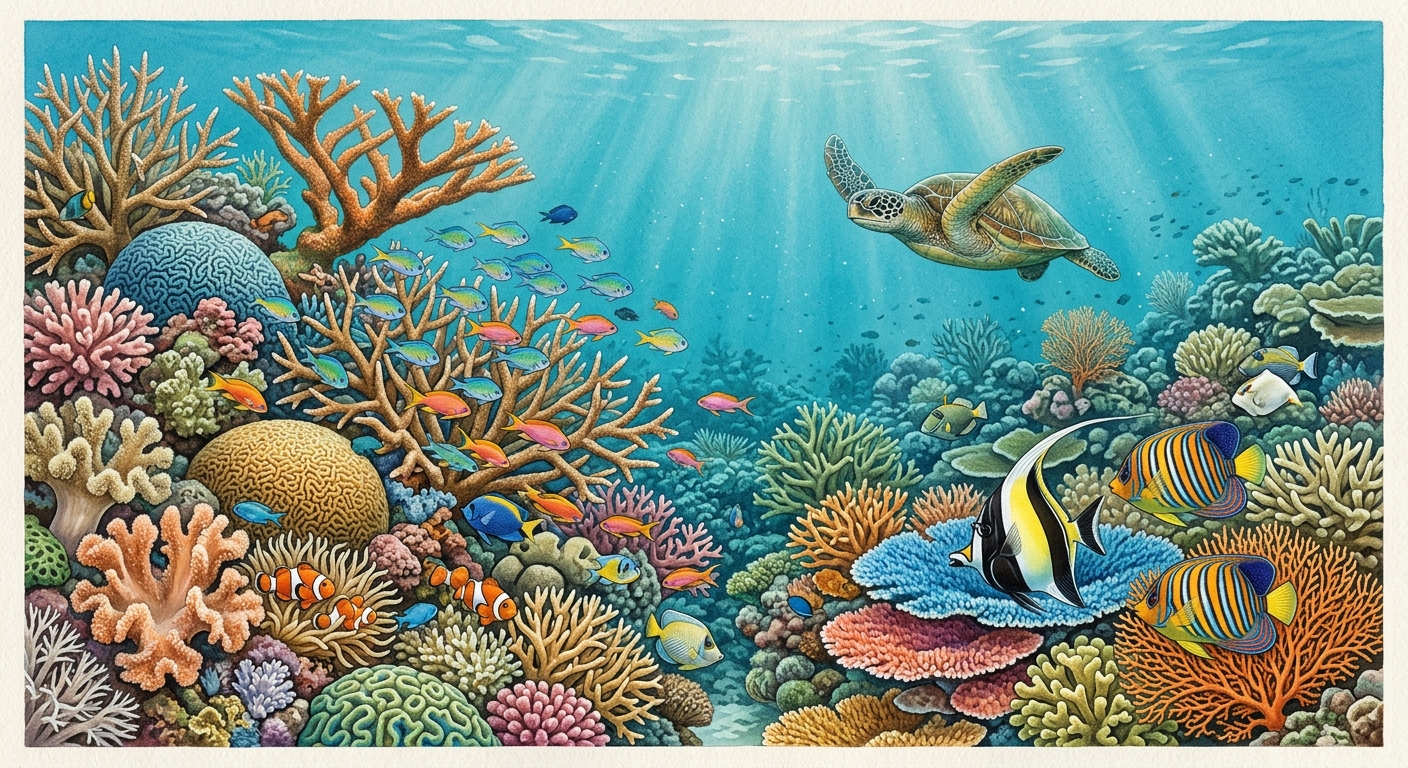
The Great Barrier Reef is the world's largest coral reef system, comprising over 2,900 individual reefs and 900 islands stretching over 2,300 kilometers off the coast of Queensland, Australia. It is a UNESCO World Heritage Site and one of the most biodiverse ecosystems on Earth, supporting thousands of marine species including corals, fish, mollusks, and marine mammals.
Overview
The Great Barrier Reef is not a single species but rather an extensive marine ecosystem built by billions of tiny coral polyps of hundreds of different coral species. This massive structure, visible from space, has been forming for approximately 20 million years, with the current reef structure dating back around 6,000-8,000 years. The reef system creates a complex three-dimensional habitat that supports an extraordinary diversity of marine life, including over 1,500 fish species, 400 coral species, 4,000 mollusk species, and numerous marine reptiles, birds, and mammals. The reef ecosystem functions through intricate symbiotic relationships, most notably between coral polyps and zooxanthellae algae. These microscopic algae live within coral tissues and provide corals with nutrients through photosynthesis, while the corals provide the algae with protection and access to sunlight. This relationship is fundamental to reef-building and the vibrant colors associated with healthy coral reefs. The reef structure itself provides shelter, feeding grounds, and nursery areas for countless marine organisms, creating one of the most productive ecosystems on the planet. The Great Barrier Reef faces significant threats from climate change, ocean acidification, crown-of-thorns starfish outbreaks, coastal development, and water quality decline. Rising ocean temperatures have caused repeated mass coral bleaching events, particularly severe in 2016, 2017, and 2020, leading to widespread coral mortality. These disturbances have profound implications for the entire ecosystem and the hundreds of species that depend on it. Conservation efforts include water quality improvement programs, coral restoration projects, crown-of-thorns starfish control, and climate change mitigation initiatives. The reef generates substantial economic value through tourism and fishing industries, supporting approximately 64,000 jobs and contributing billions of dollars annually to the Australian economy. It also provides critical ecosystem services including coastal protection, carbon sequestration, and serving as a genetic reservoir for marine biodiversity. Indigenous Australian peoples, including the Aboriginal and Torres Strait Islander communities, have maintained deep cultural and spiritual connections to the reef for over 60,000 years.
How to identify
The Great Barrier Reef is identified as a vast underwater structure visible from aerial views and satellite imagery, appearing as a patchwork of turquoise, blue, and green waters interspersed with coral formations. Individual coral colonies vary widely in form, including branching staghorn and elkhorn corals, massive boulder corals, plate corals, and delicate soft corals in diverse colors ranging from browns and greens to brilliant blues, purples, and pinks when healthy. The reef system is characterized by distinct zones including the shallow reef crest, reef flat, and deeper reef slopes, each supporting different coral and fish assemblages. Bleached corals appear stark white, indicating stress or symbiont loss.
Habitat
The Great Barrier Reef occupies warm, clear, shallow tropical and subtropical waters of the Coral Sea, ranging from depths of less than 1 meter to over 100 meters. The reef system thrives in waters with temperatures between 18-30°C, high salinity, low nutrient levels, and high light penetration. Different reef zones support distinct communities: shallow reef flats and crests support hardy corals adapted to wave action and occasional air exposure, while deeper slopes harbor light-limited species. The reef includes diverse microhabitats such as coral gardens, sandy lagoons, seagrass beds, and mangrove-fringed islands.
Distribution
The Great Barrier Reef extends approximately 2,300 kilometers along the northeast coast of Australia, from the Torres Strait near Papua New Guinea southward to just north of Bundaberg in Queensland. It spans a width of 60 to 250 kilometers offshore and covers an area of approximately 344,400 square kilometers. The system includes over 2,900 individual reefs and approximately 900 islands, ranging from small sandy cays to large continental islands. The reef is divided into northern, central, and southern sections, each with distinct characteristics and levels of human impact.
Diet
Coral polyps obtain nutrition through multiple pathways: primarily through photosynthesis by symbiotic zooxanthellae algae living in their tissues, which can provide up to 90% of the coral's energy needs; supplemented by filter-feeding on zooplankton, small fish larvae, and organic particles captured by tentacles equipped with stinging cells (nematocysts). The reef ecosystem as a whole supports diverse feeding strategies among its inhabitants, including herbivorous fish grazing on algae, planktivorous fish feeding in the water column, carnivorous predators, detritivores, and filter feeders. Nutrient cycling within the reef is highly efficient, with most nutrients rapidly recycled through the food web.
Behavior
Coral polyps exhibit daily behavioral cycles, extending tentacles at night to capture plankton and retracting during the day when photosynthesis by zooxanthellae is most productive. Corals reproduce both asexually through fragmentation and budding, allowing colony expansion, and sexually during mass spawning events. The reef ecosystem displays remarkable resilience mechanisms including coral recruitment, herbivory control of algae, and habitat regeneration following disturbances. However, recovery capacity is compromised by increasing frequency and severity of bleaching events. The reef structure itself modifies local oceanography, creating nutrient upwelling zones and wave attenuation that influences regional ecology.
Reproduction & life cycle
Coral reproduction includes both asexual and sexual strategies. Asexual reproduction occurs through budding, fragmentation, and polyp bail-out. Sexual reproduction involves mass spawning events, typically occurring 4-6 days after the full moon in October-November when water temperatures are optimal. During these synchronized events, hundreds of coral species simultaneously release egg and sperm bundles that float to the surface, where fertilization occurs. Fertilized eggs develop into planula larvae that drift in ocean currents for days to weeks before settling on suitable substrate and metamorphosing into polyps. Successful recruitment depends on finding hard substrate, avoiding predation, and establishing zooxanthellae symbiosis. Colony growth is slow, with massive corals growing 5-25 millimeters per year.
When to look
Coral spawning occurs primarily in October-November during spring following the full moon. Summer months (December-March) bring warmer water temperatures, increased storm activity, and higher risk of coral bleaching. Winter months (June-August) offer clearer water visibility and calmer conditions favorable for diving and tourism. Seasonal oceanographic patterns including monsoonal influences affect water quality, temperature, and nutrient delivery. Mass bleaching events have occurred most frequently during late summer heat stress periods.
Cultural significance
The Great Barrier Reef holds profound cultural and spiritual significance for Aboriginal and Torres Strait Islander peoples, who have maintained connections to sea country for over 60,000 years through traditional ownership, oral histories, Dreamtime stories, and sustainable resource management practices. Over 70 Traditional Owner clan groups have cultural and legal rights to reef areas. The reef has inspired countless artistic, literary, and scientific works and serves as an iconic symbol of marine biodiversity and conservation challenges. It attracts millions of tourists annually and supports commercial and recreational fishing industries. The reef is recognized globally as a natural wonder and serves as a focal point for climate change awareness and marine conservation efforts.
Similar species
- New Caledonia Barrier Reef
- Belize Barrier Reef
- Red Sea Coral Reefs
Watch on YouTube
Search YouTube for "Great Barrier Reef documentary coral ecosystem 4K"Share notes, corrections, or add local knowledge. Text · Images · Videos · Links.